Showing posts with label Summary. Show all posts

#165 Summary of Genetic technology

 1 Gene technology involves altering the genes in an organism, which is then said to be genetically modifi ed.

 2 The usual way of genetically modifying bacteria is to insert a plasmid containing the desired gene into them.


 3 The steps involved in the production of bacteria capable of synthesising human insulin are:
   identifying the human insulin gene;
   isolating mRNA and making cDNA using reverse transcriptase;
   cloning the DNA using DNA polymerase;
   inserting the DNA into a plasmid vector using restriction enzymes and DNA ligase;
   inserting the plasmid vector into the host bacterium;
   identifying the genetically modifi ed bacteria;
   cloning the bacteria; and harvesting the human insulin.

 4 The main advantage of treating diabetics with human insulin produced by gene technology is that it is chemically identical to the insulin that they would have produced had they not been diabetic. It also avoids any ethical issues that may arise from the use of insulin derived from an animal.

 5 A promoter must be inserted along with the gene, because bacteria will not express a gene unless a suitable promoter is present.

 6 The bacteria that have taken up the gene can be identifi ed using resistance to antibiotics or the presence of a fluorescing protein as markers.

 7 Gene technology can provide benefits in, for example, agriculture, medicine and industry, but has the associated risk of the escape of the gene concerned into organisms other than the intended host. The risk is seen to be particularly high for genetically modified crops that are released into the environment to grow.

 8 The social implications of gene technology are the benefi cial or otherwise effects of the technology on human societies.

 9 Ethics are sets of standards by which a particular group of people agree to regulate their behaviour, distinguishing an acceptable from an unacceptable activity. Each group must decide, first, whether research into gene technology is acceptable, and then whether or not it is acceptable to adopt the successful technologies.

10 Electrophoresis is a technique that can be used to separate lengths of DNA (or RNA or proteins) of different sizes by applying an electric current to them. Small fragments move faster and therefore further than large ones, and can be made visible using radioactive labels or fluorescent compounds. Electrophoresis is used in genetic profi ling (genetic fingerprinting) and in DNA sequencing.

11 Cystic fibrosis is a genetic disease caused by a recessive allele of the gene that codes for the production of a chloride transporter protein called CFTR. People with two copies of the recessive allele produces thick, sticky mucus in their lungs, pancreas and reproductive organs.

12 Several attempts have been made to insert normal alleles of the CFTR gene into people with cystic fibrosis, a process called gene therapy. So far, there has been only limited success, because it is difficult to get the alleles into the cells. Even when this is successful, it needs to be repeated at frequent intervals because the cells have a very short natural lifespan.

13 Genetic screening involves testing people to find out if they carry any faulty alleles for genes that can cause disease. Genetic counsellors may help people who find that they have a disease-causing allele, or that their unborn child has, to make a decision about how to act on this information.


1. End-of-chapter questions

1   Different enzymes are used in the various steps involved in the production  of bacteria capable of synthesising a human protein. Which  step is catalysed by a restriction  enzyme?

   A  cloning DNA
   B  cutting open a plasmid vector
   C  producing  cDNA from mRNA
   D  reforming the DNA double helix

2  What  describes a promoter?

   A  a length of DNA  that controls the expression of a gene B  a piece of RNA that binds to DNA  to switch off a gene C  a polypeptide  that binds to DNA  to switch on a gene
   D  a triplet code of three DNA  nucleotides  that codes for 'stop'

3  Which statement  correctly describes the electrophoresis of DNA  fragments?

   A  Larger fragments of DNA  move more rapidly to the anode than smaller fragments. 
   B  Positivelycharged  fragments of DNA  move to  the anode.
   C  Small negatively charged fragments of DNA  move rapidly to the cathode.
   D  Smaller fragments of DNA  move more rapidly than larger fragments.


4  The table shows enzymes that are used in gene technology. Copy and complete  the table to show the role of each enzyme.


5  Rearrange the statements  below to produce  a flow diagram showing the steps involved in producing  bacteria capable of synthesising a human  protein  such as human  growth hormone  (hGH).

  1.  Insert  the plasmid  into  a host  bacterium.
  2.  Isolate mRNA  for hGH.
  3.  Insert  the DNA  into  a plasmid  and  use ligase to  seal the 'nicks'  in the sugar-phosphate     chains.
  4.  Use DNA  polymerase  to  clone the DNA.
  5.  Clone  the modified  bacteria  and harvest  hGH.
  6. Use reverse transcriptase  to produce  cDNA.

  7.  Use a restriction  enzyme  to  cut a plasmid  vector.

6    a    Genetic   fingerprinting    reveals  the  differences   in variable   number   tandem   repeats  (VNTRs)    in the  DNA   of different   individuals.    Explain   what  is meant   by a VNTR.                                                                          [3]
      b    Examine   the  figure,  which   shows  diagrammatic   DNA   profiles  of a mother,   her  child  and  a possible  father  of the  child.  Decide,   giving  your  reasons,  whether   the  possible  father  is the  actual  father  of the  child. [3]


[Total: 6]
7    a    Copy  and  complete   the  table  to explain   the  roles  of primers   and  dideoxynucleotides    in DNA   sequencing.


[3]

    b    Explain   what  is meant   by:
       i gene  therapy    [1]
       ii genetic   screening  [1]
       iii   genetic   counselling.  [1]

   c    Explain   why  it is easier  to  devise  a gene  therapy   for  a condition    caused  by a recessive  allele  than  for one  caused by a dominant    allele.        [5]                                                                                                                                                                 

[Total:  11]

   8 a   Draw  a genetic  diagram   to show  how  two  heterozygous    parents   may  produce   a child  with  cystic  fibrosis. Use the  symbols  A/a  in your  diagram.   [3]

     b   State  the  probability  of one  of the  children   of these  parents   suffering   from  cystic  fibrosis.  [1]
 [Total:  4]


The figure  shows  the  CFTR   (cystic  fibrosis  transmembrane    conductance     regulator)    protein   in  a cell surface  membrane.

a  i Describe   the  normal   function    of the  CFTR   protein.       [2]                                                         ii   Use  the  letter  E to indicate   the  external   face of the  membrane.     State  how  you  identified    this  face.                        [1]

b Cystic fibrosis  is caused  by a recessive  allele  of the  CFTR gene.
   i Explain   the  meaning   of the  term  recessive   allele.                            [2]
   ii   Explain   how  cystic  fibrosis  affects  the  function    of the  lungs.           [3]                                                                    
c  As cystic fibrosis  is caused  by a recessive  allele  of a single  gene,  it is a good  candidate    for gene  therapy.  Trials were undertaken    in  the  1990s,  attempting     to deliver  the  normal   allele  of the  CFTR gene  into  cells of the respiratory   tract,  using  viruses  or  liposomes   as vectors.   Explain   how  viruses  deliver  the  allele  into  cells.                     [2]

d  In some  people  with  cystic  fibrosis,   the  allele  has  a single-base   mutation    which   produces   a 'nonsense'    (stop) codon  within   the  gene.

   i Expalin   how  this  mutation    would   prevent   normal   CFTR   protein   being  produced.    [2]                                                
  ii A new  type  of drug,   PTCI24,     enables   translation    to continue    through    the  nonsense   codon.   Trials  in  mice homozygous    for a CFTR allele  containing    the  nonsense   codon   have  found   that  animals   treated   with PTC124    produce   normal   CFTR   protein   in  their  cells. The  drug  is taken  orally  and  is readily  taken   up into  cells allover   the  body.

Using  your  knowledge  of the  progress   towards   successful   gene  therapy   for  cystic  fibrosis,   suggest  why PTC124    could  be a simpler   and  more  reliable   treatment    for  the  disease.    [3]                                                                     
[Total:   15]

[Cambridge International  AS and A Level Biology 9700/04,   Question 2,  October/November 2008]


2. End-of-chapter answers

 1  B
 2  A
 3  D


Exam-style questions


6 a VNTR: a short length of highly repetitive DNA; 
       number of repeats and hence lengths of repeats diff er markedly in diff erent individuals;                      inherited: half VNTRs from father, half from mother; 
        only identical twins have the same VNTRs; [max. 3]

  b four bands in child’s profile match four of the bands in the mother’s; 
      the other four bands match four bands in the father’s profile; 
       the possible father is the actual father; [3]
 [Total: 6]


  b i gene therapy: treatment of a genetic disorder by altering the patient’s genotype; [1] 
     ii genetic screening: determination of a person’s genotype using karyotype analysis for chromosome mutations and probes for identifying particular alleles; [1] 
    iii genetic counselling: a service that seeks to explain the nature of genetic disorders and probability of their transmission; [1] 

 c when a genetic disorder is caused by a recessive allele, the ‘normal’ allele is dominant; 
    adding a dominant allele allows some correct product to be made; the individual effectively becomes heterozygous; 
   the recessive allele may code for defective product or no product; 
   production of some correct product may cure the disorder; 
  adding a recessive allele cannot block a faulty dominant allele; [max. 5]
   [Total: 11]

 8 a


correct gametes; correct genotypes; correct phenotypes; [3]

b 1 in 4/0.25/25%; [1] 
 [Total: 4] 

9 a i chloride channel; chloride moves out of cell by active transport; [2] 
     ii upper face because of presence of carbohydrate chains; [1]

 b i allele: variant form of a gene; recessive: only aff ects phenotype when dominant allele is not present; [2] 
     ii thick, sticky mucus produced; mucus accumulates; reduced gas exchange; more infections; [max. 3] 

 c normal dominant CFTR allele added to viral DNA; 
  virus inserts DNA into cell; [2] 

 d i translation stopped at ‘stop’ codon; protein chain not completed; [2] 
   ii comparisons include: drug easily taken up by cells, whereas therapy is poorly taken up; 
    drug taken orally, whereas therapy must be inhaled into lungs; 
   no vector needed for drug, whereas virus vector for therapy may cause side-eff ects; [3] 
 [Total: 15] 


#154 Summary Biodiversity and conservation

1 All living organisms may be classified into one of the five kingdoms: prokaryotes, protoctists, fungi, plants and animals.

2 Biodiversity includes the range of habitats (environments) and species in an area, and the genetic diversity within a species.


3 There are moral and ethical reasons for maintaining biodiversity, and also more practical ones. For example, we may be able to use plants to provide medicines, and animals to provide alleles to use in animal breeding.

4 Species may become in danger of extinction through habitat loss, change to their environment (perhaps as a result of pollution) and overexploitation by humans.

5 Conservation of an endangered animal species may involve captive breeding programmes, in which viable populations are built up in zoos and wildlife parks. These programmes try to ensure that the gene pool is maintained and inbreeding is avoided. At the same time, attempts are made to provide a suitable habitat in the wild, so that captive-bred animals can eventually be re-released into the wild. Local people are involved, because this increases acceptance of the project and the chances of its success.

6 Botanic gardens and seed banks help to conserve threatened plant species by breeding them for reintroduction into an appropriate habitat. Seed banks provide suitable conditions to keep different types of seeds alive for as long as possible. Samples of the seeds are grown into adult plants every now and then, so that fresh seed can be collected.

7 Many countries have protected areas called national parks, which often cover large areas. These are set up to conserve rare and endangered species and to maintain their habitats. Often legislation is passed to ensure their protection. In such areas, agriculture is controlled and building, mining and other industries strictly regulated. Access is often limited but not forbidden, as one aim of most such parks is to educate people about the importance of conservation. 8 Other, smaller, conservation areas may be created to protect particular species and habitats.

1. End-of-chapter questions

 Which organism is a fungus?


2   Which   of the  statements    about   Protoctista    are correct?
   1   a eukaryote   that  is not  a fungus,   plant   or animal   is a protoctist
   2    an organism   with  cellulose  cell walls  and  chloroplasts    may  be a protoctist
   3    an organism   existing  as a group   of similar  cells may  be a protoctist
   4    a single-celled   heterotrophic     eukaryote   is a protoctist

 A   1,2,3 and  4          B   1, 2 and 4 only  C   2 and 3 only           D 3 and 4 only


3   A gene  bank  is a store  of the  genetic  variation   of a species.  Which   of the  following   are gene  banks?
1   captive  animals   in a zoo                                                                     
2    plants  in a botanic   garden
3    seeds in a seed bank
4    plant  cells growing   in tissue  culture
5   frozen  sperm,   eggs or embryos

A  1, 2, 3, 4 and 5   B   1, 2 and 3 only      C  2, 3 and  4 only   D   3, 4 and  5 only


4   Copy  and  complete   the  table  to show  the  features   present   in the  five different   classificatory   Kingdoms    of living organisms.   Use a tick  (V")   to show  the  presence   of a feature  and  a cross  (x)  to show  its absence.
Add caption
5   Distinguish   between   orthodox    and  recalcitrant     seeds.
6   a    Explain  what  is meant   by biodiversity. [2]
     b    Over  half  of the  living  species  of plants   and  animals   live in  tropical   rainforests.    Suggest  why  this  is so. [4]
    c    Some  rainforest   species,  for  example   the  squirrel   monkey   in Costa  Rica,  are endangered.    Suggest  four  ways to  conserve  an animal   species  such  as the  squirrel   monkey.[4]
   d    List four  practical   reasons  why  humans   should   try  to maintain    biodiversity. [4]
[Total:   14]

7 a In  many   cases,  the  reason   for  an  organism    becoming    endangered    is the  loss of its habitat   as a result  of human activity.   List  four ways  in which   human    activity   causes  habitat   loss. [4]
       b In  1973,  the  population  of African   elephants  in  Kenya was about 167000 animals,  but  by 1989 the population had  dropped to about 16000  animals. In  2010 the  population had  risen  to  about  36000  animals. Suggest explanations for  these  changes. [6]
c Explain: 
             i  how  captive   breeding   of animals,   such  as the  scimitar-horned    oryx,  can  help  conserve   an endangered    species; [3]
            ii  how genetic diversity can be maintained  during a captive breeding programme.     [3] 
[Total:  16]


8  The  American  crocodile,  Crocodylus acutus, was classified  as an endangered  species  by the  USA  in  1975.  It is found in  estuarine  regions  of southern  Florida.

The  salinity   of the  water  was  thought    to  playa   part  in  the  distribution     of the  American    crocodile.   The  figure  shows the  number    of American    crocodile   nest  sites  in  areas  with  water  of varying   salinity   in southern    Florida.

a    Describe   the  results  shown   in  the  figure.               [3]

b    Much   conservation   work  has  been  done  in  the  Everglades   National    Park  in  Florida,   which   is a large wetland area.  As a result,   the  number    of nest  sites  increased   from  eight  in  1975  to 31  in 2000.   This  led  to a rise in the number    of crocodiles.  

  i  Calculate    the  percentage    increase   in  nest  sites  between    1975  and  2000.   Show  your  working.[2]
  ii    Suggest   two  reasons  why  the  population     of crocodiles   in  the  Everglades   National    Park  has  increased.[2]
[Total:  7]

[Cambridge International  AS and A Level Biology 9700/42,   Question 1, Mayljune2010,]                                                                                                          


2. End-of-chapter answers
 1 D
 2 A
 3 A
 4

5 orthodox seeds: can be dehydrated and frozen for long-term storage;

   recalcitrant seeds: cannot be dehydrated and frozen;


Exam-style questions


6 a biodiversity:
      range/variety, of, species/communities/ecosystems;
      the genetic variation within a species;
      the genetic variation between species; [max. 2]

  b high rate of photosynthesis/rapid growth of plants; allows large number of plant species;
     available throughout the year;
      provides niches for large number of animal species; [4]

 c maintain as a captive population in a zoo/captive breeding;
    set up conservation area/protect habitat from clearance;
    ban, hunting/capture;
   educate public/introduce ecotourism; [4]

d as resource for, food/materials;
    as source of alleles for breeding to improve agricultural species;
    as potential medicines; for ecotourism/leisure;
    to maintain, food webs/nutrient cycles; [max. 4]
 [Total: 14]

7 a clearing land for agriculture;
      clearing land for housing;
      clearing land for industrial building;
      clearing land for, road building/railways/pipelines/
     other infrastructure;
     mining;
     logging;
     pollution/global warming; [max. 4]

 b fall from 167 000 to 16 000 due to a combination of factors including:
    ivory hunting;
    game hunting;
    hunting for meat;

    killing after damage to village crops;
   habitat loss;
    rise after 1989 due to ban on ivory trading;
    rise only to 36 000 because other factors still apply: habitat loss;
   poaching;
   killing after damage to village crops; [max. 6]

c i bred in several places so not all at risk from same disease;
     increased numbers of animals;
     allows return of animals to wild; [3]

  ii close relatives are not interbred; e.g. siblings/father with daughter;
    in-vitro fertilisation used to breed from distantanimals;
    refer to embryo donation and use of surrogates; [max. 3]
 [Total: 16]
8 a more nests in less saline areas;
     22 nests at 0–5 parts per thousand compared with 1 at 31–35 parts per thousand;
     anomalous result for 16–20 parts per thousand; [3]


       ii more fresh water/lower salinity;
          sites protected;
          ecotourism encouraged;
          ban on hunting;
          less pollution; [max. 2]
 [Total: 7]


#143 Summary of Selection and Evolution

1 Genetic variation within a population is the raw material on which natural selection can act. 

2 Meiosis, random mating and the random fusion of gametes produce genetic variation within populations of sexually reproducing organisms. Variation is also caused by the interaction of the environment with genetic factors, but such environmentally induced variation is not passed on to an organism’s off spring. The only source of new alleles is mutation. 


 3 All species of organisms have the reproductive potential to increase the sizes of their populations, but, in the long term, this rarely happens. This is because environmental factors come into play to limit population growth. Such factors decrease the rate of reproduction or increase the rate of mortality so that many individuals die before reaching reproductive age. 

 4 Within a population, certain alleles may increase the chance that an individual will survive long enough to be able to reproduce successfully. These alleles are therefore more likely to be passed on to the next generation than others. This is known as natural selection. 

 5 Normally, natural selection keeps allele frequencies as they are; this is stabilising selection. However, if environmental factors that exert selection pressures change, or if new alleles appear in a population, then natural selection may cause a change in the frequencies of alleles; this is directional selection.

6 Over many generations, directional selection may produce large changes in allele frequencies. This is how evolution occurs. 

 7 The evolution of antibiotic resistance in bacteria and the spread of industrial melanism in moths are examples of changes in allele frequencies. The role of malaria in the global distribution of sickle cell anaemia is an example of how two strong opposing selection pressures can counterbalance each other in maintaining two alleles within certain populations. 

 8 A species can be defi ned as a group of organisms with similar morphology, behaviour, physiology and biochemistry that are capable of interbreeding to produce fertile off spring. In practice, however, it is not always possible to determine whether or not organisms can interbreed. 

 9 New species arise by a process called speciation. In allopatric speciation, two populations become isolated from one another, perhaps by some geographical feature, and then evolve along different lines until they become so diff erent that they can no longer interbreed. In sympatric speciation, new species may arise through polyploidy. 

 10 Artificial selection involves the choice by humans of which organisms to allow to breed together, in order to bring about a desirable change in characteristics. Thus artificial selection, like natural selection, can aff ect allele frequencies in a population.

1. End-of-chapter questions

1   Which of the  following gives rise to genetic variation in a population?
   1    crossing   over  and  independent     assortment    in  meiosis
   2    different   environmental     conditions
   3    random    mating   and  fertilisation
   4    mutation
   A   1,2,3 and  4          B  1, 2 and 3 only           C  1, 3 and 4 only           D  2, 3 and 4 only


2    A species of finch living on an isolated island shows variation in beak size. Birds with larger  beaks can eat larger seeds.

After a period of drought on the island, large seeds were more plentiful than small seeds and the  average size of the finches' beaks increased.

What explains this increase in size of beak?
A  artificial  selection  acting against finches with small beaks
B   directional  selection acting  against finches with small beaks
C   increased rate of mutation  resulting in finches with larger beaks
D   stabilising selection acting against finches with the smallest and largest beaks

3  Which   effect  of natural   selection   is likely  to lead  to  speciation?
A   Differences   between   populations     are increased.
B   The  range  of genetic  variation   is reduced.
C   The  range  of phenotypic    variation   is reduced.
D  Favourable   alleles  are maintained     in  the  population.

4  There  are three  genotypes   of the  gene  for  the  β-globin  polypeptide: HbAHbA,  HbAHbs   and  HbsHbs.


Copy  and  complete    the  table  to  show  which   genotypes   have  a selective  advantage   or  disadvantage   in different regions  of the  world.


5  The wings  of butterflies   are covered  with  microscopic    scales  that  give them   their  colour   and  also provide waterproofing.

The wings  of some  species  have  large  transparent    areas  through   which   the  colour   of the  vegetation    on  which   the butterfly  has  settled   can  be seen.  Because  they  lack  scales,  these  areas  have  poor  waterproofing.    The  butterflies    are eaten  by birds.

  a    Describe   two  selection   pressures   that  are likely  to  control   the  size of the  transparent           areas  of the  wings  of these  butterflies.
  b   In what  circumstances   might   there  be selection   for larger  transparent     areas  in  the            wings?

6   Rearrange   the  order  of the  following   statements    to  give a flow  diagram   showing   the  evolution    of resistance   to the antibiotic    streptomycin   by the  bacterium    Escherichia   coli.

  1.  Most   of  the  population of E. coli is resistant    to  streptomycin.
  2.  A mutation     in  a DNA  triplet   of a plasmid,    changing    TTT    to TTG,    gives  an  E. coli bacterium resistance    to  streptomycin.
  3.  The  resistant    bacterium     divides   and  passes  copies   of  the  R plasmid    to  its  offspring.
  4. Sensitive   bacteria    die  in  the  presence    of streptomycin    as a selective   agent.
  5. The  frequency    of  the  mutated    gene  in  the  population      increases.
  6.  The  resistant    bacterium     has  a selective   advantage    and  survives.

7   Copy and complete  the table to compare artificial selection with natural  selection.


8   Pale and dark peppered  moths were collected and placed on pale and dark areas of bark on trees in a park in Liverpool, England.  Some of the moths were predated  by birds. The results of the investigation  are shown in the table.

 a 40 dark moths were placed on dark bark. Calculate  the number  of moths  taken by birds. Show your working. [2]
  b  Suggest an explanation  for the differences in the numbers  of moths  taken by birds. [4]

[Total:  6]

9   The snail Cepaea  nemoralis  may have a yellow, pink or brown shell. Each colour shell may have up to  five dark bands, or have no bands. Both shell colour and number  of bands are genetically controlled.  The snails are eaten by birds such as thrushes, which  hunt  by sight.

The following observations  were made:

•    Most  snails living on a uniform   background,   such  as short  grass, have no bands.
•    Most  snails living on a green background,   such  as grass, are yellow.
•    Most  snails living on a non-uniform    background,   such  as rough  vegetation,   have bands.

a   Suggest an explanation  for these observations.  [4]
b   Predict the phenorype  of snails living on a dark background  of dead leaves.[2]
c   Suggest what will happen,  during  the course of a year, to the frequencies of the different alleles controlling shell colour and banding  in a snail population  living in deciduous woodland.  (Deciduous  trees shed their leaves in autumn.  The background  for the snails will be made up of dead leaves in the autumn  and winter, and green vegetation  in the spring and summer.)[4]

 [Total: 10]

10 The heliconid   butterflies   of South  America   have  brightly   coloured   patterns   on  their  wings.  A hybrid   between   two species, Heliconius   cydno and  H   melpomene,   has wing  patterns   that  are different   from  both  parental   species.

An investigation   was carried  out  to see whether   the  hybrid   was a new  species.

Separate groups  of four  butterflies,   each  consisting   of a male  and  female  of one  of the  parental species  and  a male  and female of the  hybrid,   were  placed   together   and  their  choices  of mates  recorded.   The  results  are shown   in the  table.


a    With  reference   to the  information     in  the  table,  explain  whether   or not  the  results  of the  investigation    suggest that  the hybrid   butterfly   is a separate   species. [4]
b    Suggest how  the    ybrid  could  be reproductively    isolated   from  the  two  parent   species  of butterfly. [2]
c    Briefly describe  how  allopatric   speciation    can  occur.[4]

[Total:   10]

2. End-of-chapter answers
 1 C
 2 B
 3 A


5 a predation by birds, tending to increase the size of the transparent areas of the wings as they              increase camoufl age;
      rainfall, because smaller transparent areas give an advantage;

b increased predation/drier conditions;

 6 2, 4, 6, 3, 5, 1
 1 mark for every 2 correct answers


Exam-style questions


8 a 40 × 40 ÷ 100 = 16; [2] 
   b pale moths are camouflaged on pale bark, and dark moths on dark bark; 
       predators/birds, hunt by sight; 
       fewer moths taken that match bark; 
       refer to figures: 20% v. 44% of pale moths/15% v. 40% of dark moths; [4] 
 [Total: 6] 

9 a camouflage from bird predators hunting by sight; 
      yellow blends into grass but pink or brown are easily seen; 
      bands break up outline against rough vegetation; 
     yellow or pink without bands are easily seen; [4] 

  b brown/five bands; [2] 

  c selection favours alleles for brown shell and for bands in autumn and winter; 
    selection favours alleles for yellow shell and few or no bands in spring and summer; 
    gradual change in selection pressures as seasons change;  
    keeps all alleles in the population; [4] 
  [Total: 10]

10 a behaves as good species with no intermating in relation to H. melpomene; 
    15 matings between H. melpomene males and females and between hybrid males and females;             behaves as less good species in relation to H. cydno; 
    no matings between H. cydno males and hybrid females; 
    but three matings between H. cydno females and hybrid males; [max. 4] 

   b select mates on basis of wing colours and patterns; 
      hybrid wing pattern sufficiently different from parent species to give good isolation from H.                 melpomene; [2] 

   c  needs geographical separation; 
     selection pressure diff erent in the separated populations; 
     different alleles selected for; 
     in time the diff erences between the two populations are so great that they do not interbreed should      they happen to meet; [4] 
 [Total: 10]


#136 Summary of Inherited change

1 Meiosis consists of two divisions. The first division, meiosis I, separates the homologous chromosomes, so that each cell now has only one of each pair. The second division, meiosis II, separates the chromatids of each chromosome. Meiotic division therefore produces four cells, each with one complete set of chromosomes.


2 Diploid organisms contain two copies of each gene in each of their cells. In sexual reproduction, gametes are formed containing one copy of each gene. Each off spring receives two copies of each gene, one from each of its parents.

3 The cells produced by meiosis are genetically different from each other and from their parent
cell. This results from independent assortment of the chromosomes as the bivalents line up on the
equator during metaphase I, and also from crossing over between the chromatids of homologous
chromosomes during prophase I.

 4 Genetic variation also results from random fertilisation, as gametes containing diff erent varieties
of genes fuse together to form a zygote.

 5 An organism’s genetic constitution is its genotype. The observable expression of its genes is its phenotype.

 6 Different varieties of a gene are called alleles. Alleles may show dominance, codominance or recessiveness. An organism possessing two identical alleles of a gene is homozygous; an organism possessing two different alleles of a gene is heterozygous. If a gene has several diff erent alleles, such as the gene for human blood groups, these are known as multiple alleles.

7 The position of a gene on a particular chromosome is its locus.

8 A gene found on the X chromosome but not on the Y chromosome is known as a sex-linked gene.

9 The genotype of an organism showing dominant characteristics can be determined by looking at the off spring produced when it is crossed with an organism showing recessive characteristics. This is called a test cross.

10 Monohybrid crosses consider the inheritance of one gene. Dihybrid crosses consider the inheritance of two diff erent genes.

11 The χ2 test can be used to find out whether any diff erences between expected results and observed results of a genetic cross are due to chance, or whether the difference is significant.

12 The genotype of an organism gives it the potential to show a particular characteristic. In many cases, the degree to which this characteristic is shown is also affected by the organism’s environment.

13 Mutation can be defined as an unpredictable change in the base sequence in a DNA molecule (gene mutation) or in the structure or number of chromosomes (chromosome mutation). New alleles arise by gene mutation. Gene mutations include base substitutions, deletions or additions. The HbS (sickle cell) allele arose by base substitution. Such mutations may affect the organism’s phenotype.


1. End-of-chapter questions

1. A cell in the process of meiosis was seen to have a spindle with sister chromatids being drawn  towards opposite poles of the cell. In what stage of meiosis was the cell?                           .
  A  anaphase I
  B  anaphase II
  C metaphase I
  D metaphase II

2  All the offspring of a cross between pure-bred  red-flowered and pure-bred white-flowered                   snapdragons were pink.

Two of these pink-flowered plants were interbred.  What proportion of the offspring were pink?
   A  25%
   B  33%
   C  50%
   D  100%

3  A man has haemophilia.  Which  statement correctly describes the inheritance  of the gene causing his condition?

   A  He inherited  the recessive allele from his mother.
   B  He inherited  the dominant  allele from his father.
   C  He can pass the recessive allele to a son.
   D He can pass the dominant  allele to a daughter.


4   The  diploid  (2n) chromosome  number of  Drosophila is 8. Copy and complete the table to show  the different outcome of mitotic and meiotic division of a Drosophila cell.


5  Copy and complete the table to compare meiosis with mitosis.


6    a    Describe the essential  difference between meiosis I and meiosis  II. 
      b    State the similarity between meiosis II and  mitosis.

7   There is no crossing over during meiosis in male Drosophila. Assuming that no mutation occurs,   the only source of genetic variation is independent assortment. Given that the diploid (2n) chromosome  number is 8, calculate the number of genetically different spermatozoa that can be produced.

8    Distinguish between the following pairs of terms. 
    a genotype and  phenotype
    b  homozygous and heterozygous

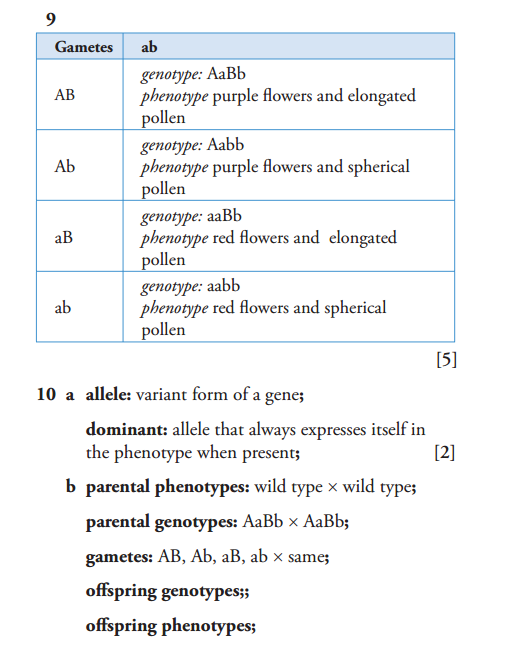
9  In sweet-pea plants, the gene A/a controls flower colour. The dominant allele gives purple flowers  and the recessive allele red flowers.

A second gene, B/b, controls the shape of the pollen grains.  The dominant allele gives elongated   grains and the recessive allele spherical grains.

A plant with  the genotype AaBb  was  test-crossed by interbreeding it with a plant with red flowers and spherical pollen grains.

Copy and complete the table to show that the expected ratio of phenotypes of the offspring of this cross. The gametes from one parent are already in the table.

[5]

10  a  The fruit fly, Drosophila melanogaster, feeds on sugars found  in damaged fruits. A fly with   normal features is called a wild  type. It has a striped body and its wings are longer than  its abdomen. There are mutant variations such as an ebony-coloured body or vestigial wings. These three types of fly are shown in the figure.


Wild-type  features are coded for by dominant alleles:  A for wild-type body and B for wild-type    wings. Explain what is meant by the terms allele and dominant. [2]

b   Two wild-type  fruit flies were  crossed.  Each had alleles A and  B and carried alleles for ebony   body and vestigial  wings.

Draw a genetic diagram to show the possible offspring of this cross.   [6]

c  When the two heterozygote flies in b were crossed, 384 eggs hatched and developed into adult   flies.
A chi-squared (X2)  test  was  carried out to test the significance of the differences between  observed   and expected results:


i  Copy and complete the table.


  [1]
ii Calculate the value for X2
The  table  below  relates X2 values to probability values.
As four classes of data were counted,  the number of degrees of freedom was 4 - 1 = 3. The table  gives values of X2 where there are three degrees of freedom.


iii Using  your  value  for  X2  and  the table above, explain whether or not the observed results were  significantly different from the expected results.                                     [2]
[Total: 14]

[Cambridge International  AS and A Level Biology 9700/41, Question 7, October/November2009]


2. End-of-chapter answers
1 B
2 C
3 A

6 a meiosis I: separates homologous chromosomes; 
      meiosis II: separates sister chromatids; 
   b both separate sister chromatids; 

7 (2n , where n = 4) 2 × 2 × 2 × 2 = 16 

8 a genotype: the genetic constitution of an organism with respect to a gene or genes; 
     phenotype: the physical, detectable expression of the particular alleles of a gene or genes present in an individual; 

  b homozygous: describes a diploid organism that has the same allele of a gene at the gene’s locus on both copies of the homologous chromosome; 
     heterozygous: describes a diploid organism that has diff erent alleles of a gene at the gene’s locus on the homologous chromosomes;

Exam-style questions